
Services · 02
Finite element analysis for pressure equipment, structures and piping.
Design by analysis where the rule equations cannot reach — carried out in industry-trusted software and assessed against the governing code. We perform the assessments required by ASME Sec VIII-2 Part 5 using the method appropriate to the failure mode and the level of demonstration required.
ASME Sec VIII-2 Part 5
The four failure modes, and the load cases that govern real equipment
Protection against plastic collapse
Elastic stress analysis with linearisation and categorisation, limit-load analysis using elastic-perfectly-plastic material and small-displacement theory, or nonlinear elastic-plastic analysis with a true stress-strain curve and large-displacement effects.
The elastic-plastic route generally gives the least conservative result, and is used where geometry makes stress categorisation unreliable.
Protection against local failure
Assessed by either route. The elastic method checks the sum of the three principal stresses against the limit, giving a quick screen but no credit for redistribution. The nonlinear elastic-plastic method evaluates the limiting triaxial strain, accounting for stress triaxiality and accumulated plastic strain, and is the route to take where the elastic check fails or where geometry is sharply discontinuous.
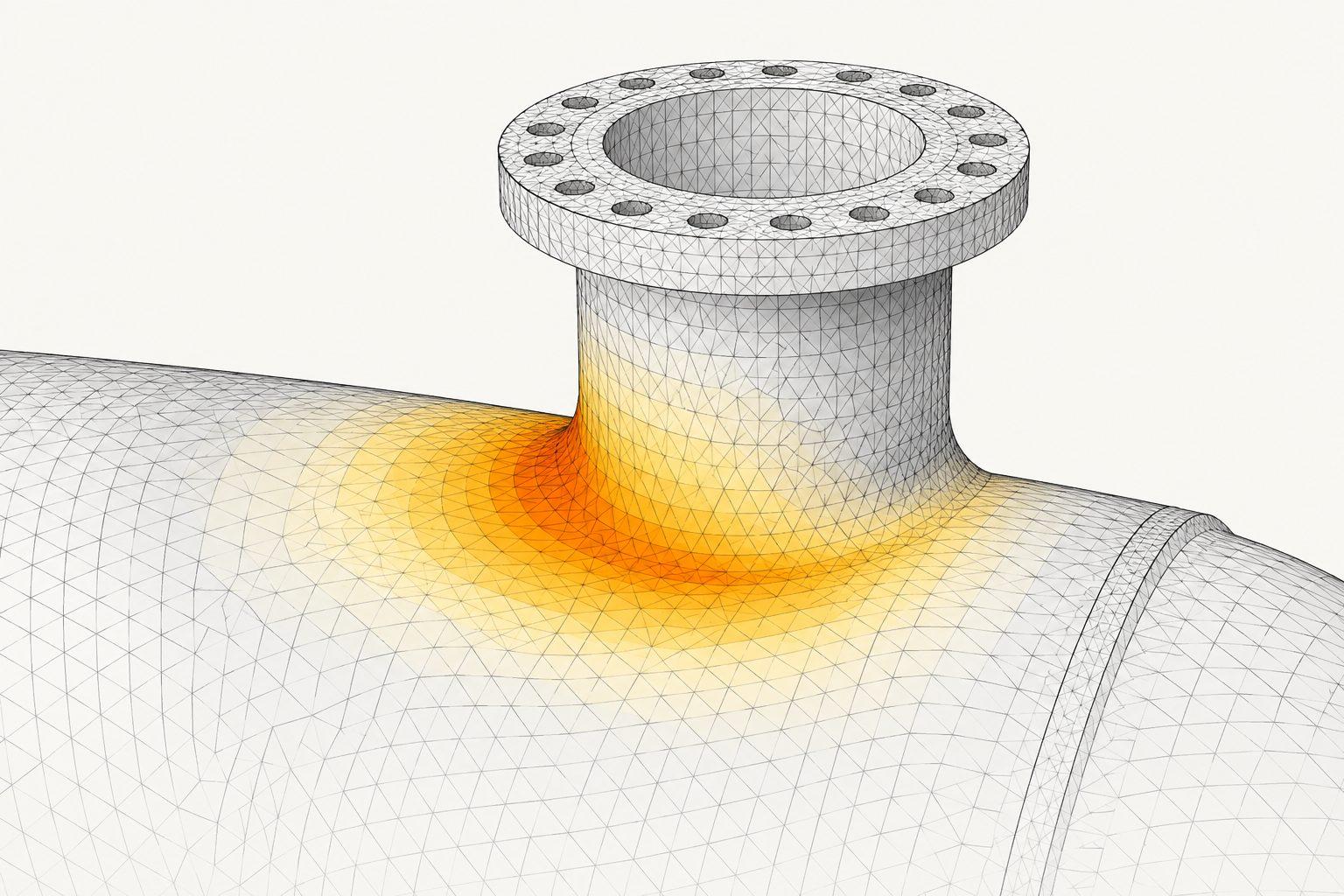
Both are applied at nozzle junctions, thickness transitions and weld toes.
Protection against collapse from buckling
Bifurcation and collapse assessment for external pressure, vacuum, axial compression and combined loading, with the design factor applied according to the analysis type used.
Protection against failure from cyclic loading
Fatigue assessment by elastic stress, elastic-plastic strain, or the structural stress method for welds, with cycle counting from the operating histogram. Ratcheting assessed by elastic analysis, or by elastic-plastic cyclic analysis where a stable state has to be demonstrated.
Seismic analysis
Modal extraction and response spectrum analysis for vessels, columns and equipment, with equivalent static methods where the structure is regular enough to permit them and time-history analysis where the project demands it. Covers support and anchorage reactions, base shear distribution, sloshing loads in partially filled vessels, and interaction between the equipment and its supporting structure.
Analysis is carried out to the requested seismic code, and results are assessed against Part 5 criteria as occasional loads.
Rigging analysis
Lifting, tailing, upending and transport conditions, which frequently govern the design of thin-walled or long vessels. Covers local stress at lifting lugs and trunnions, shell stability during the lift, sling angle effects, dynamic amplification and tailing lug loads.