
Services · 01
Pressure equipment design, calculated to the code your market accepts.
Vessels, exchangers and pressure-retaining components designed and documented under ASME, European and Canadian rules.
Plus design to any other requested code or standard. Shipping to Canada? Most pressure vessels used there need a CRN number — we prepare and submit the vessel CRN too.
Design margins
Why the same vessel comes out at three different thicknesses
| Code | Allowable stress basis | Design margin |
|---|---|---|
| ASME VIII-1 | lesser of UTS/3.5 and 2/3 × Yield | 3.5 on tensile |
| ASME VIII-2 | lesser of UTS/2.4 and 2/3 × Yield | 2.4 on tensile |
| EN 13445 — ferritic | lesser of Rp0.2/1.5 and Rm/2.4 | 2.4 tensile, 1.5 yield |
| EN 13445 — austenitic (A ≥ 30%) | Rp1.0/1.5 | 1.5 on 1.0% proof |
| AD 2000 | K/S, from yield or proof stress at temperature | 1.5 design, 1.05 test |
| PED 2014/68/EU | not a design code — sets essential safety requirements | 1.43 test pressure factor |
Values shown are the general basis for common materials at design temperature. Material class, product form and elevated-temperature or creep service change the governing criterion.
In practice
What the numbers mean
EN 13445 generally produces the highest allowable stresses of the three families, and ASME VIII-1 the lowest. Two things drive that gap. First, austenitic properties in the European code are based on a 1.0% strain offset rather than ASME’s 0.2%, which runs appreciably higher for stainless grades. Second, the European allowable is taken as the greater of two values, where ASME takes the lesser.
There is a second, quieter difference: EN 13445 considers ultimate tensile strength only at ambient temperature, while both ASME codes take tensile strength at design temperature. On a hot vessel that matters.
Lower margin is not free. Moving from Div 1 to Div 2 buys wall thickness back, but pays for it in analysis, fabrication tolerance and inspection scope. On a small vessel the saving rarely covers the extra engineering; on a heavy-wall or high-volume item it usually does.
Heat exchangers
ASME and TEMA — which one does what
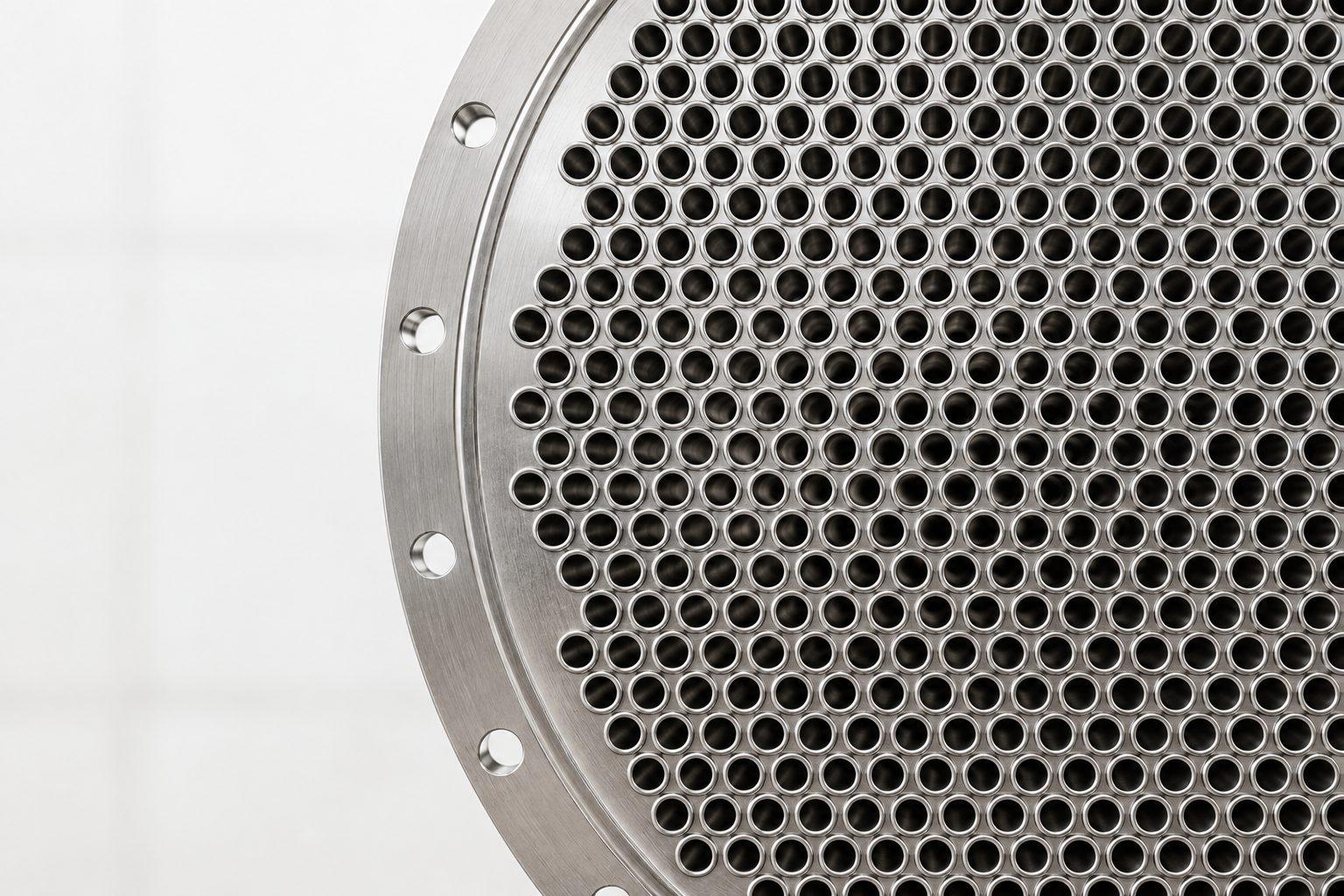
Heat exchanger design and construction rules are now explicitly covered in ASME Sec VIII-1 and Sec VIII-2, while TEMA focuses on the specific internal components and operational requirements. TEMA also provides design rules widely used as the basis for expansion joint numerical analysis.
Historically, ASME did not have mandatory rules for designing heat exchangers, and TEMA’s simpler, semi-empirical formulas filled that gap for decades. Beyond calculations, TEMA provides standardised configurations — BEM, AES and the rest — so buyers and manufacturers instantly recognise the exact type. It also dictates details such as tolerances and maintenance guidelines.
In short: TEMA is the best practice for how a heat exchanger should perform and be maintained, while ASME is the law for pressure safety.
Plate exchangers — API 662. Requirements for the mechanical design, materials selection, fabrication, inspection, testing and preparation for shipment of plate-and-frame heat exchangers for petroleum, petrochemical and natural gas service — gasketed, semi-welded and welded.